Dataset
RustMizan focuses on Rust memory-safety vulnerabilities: use-after-free, buffer overflow, double free, and related issues. Every variant traces back to a publicly disclosed CVE. The benchmark is built on real vulnerabilities, not synthetic or injected ones.
Multi-level compilable variants
Each CVE is packaged as up to three standalone compilable crates of decreasing scope.
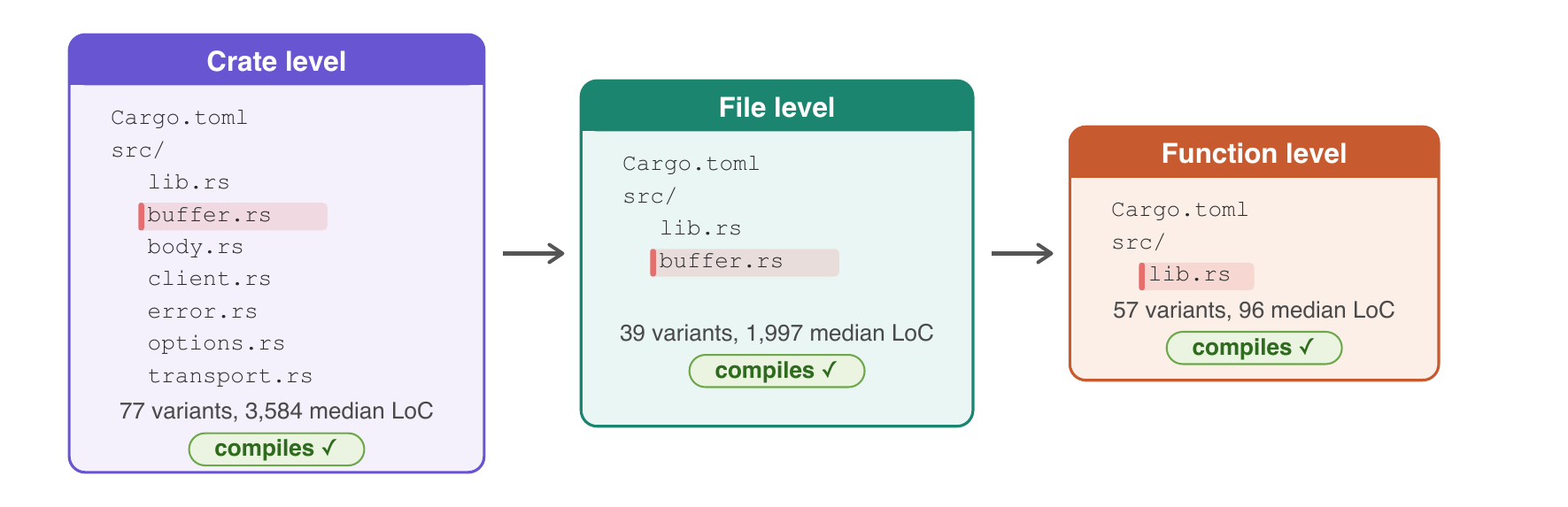
- Crate level: the full original project.
- File level: the vulnerable file plus the files and type definitions needed to compile, packaged as a standalone crate.
- Function level: just the vulnerable function and its compile dependencies.
The same vulnerability appears at all three levels, so any difference in analysis accuracy is due to context, not to the vulnerability being harder or easier. Two exceptions apply: single-file crates get only file- and function-level variants, and the function level is skipped when the file is essentially a single function.
Sourcing
The dataset draws from the RustSec Advisory Database, a community-maintained repository of security advisories for Rust crates. Each RustSec entry is mapped to its individual CVE.
- Vulnerable version: the commit before the fix, or the version immediately before the patched release.
- Patched version: the commit corresponding to the patched release from RustSec. When no official patch is recorded, only the vulnerable variant is included.
All variants are constructed manually and verified to compile. Annotations are derived from CVE descriptions, GitHub issue discussions, commit messages, and code review, and every annotation is peer reviewed by at least one additional researcher.
Directory layout
samples/
├── deps/                      # shared dependency crates
├── vuln-0001/
│   ├── README.md              # CVE description and vulnerability explanation
│   ├── sample-00001-crate/    # vulnerable, crate level
│   ├── sample-00001-file/     # vulnerable, file level
│   ├── sample-00001-function/ # vulnerable, function level
│   ├── sample-10001-crate/    # fixed, crate level
│   ├── sample-10001-file/     # fixed, file level
│   └── sample-10001-function/ # fixed, function level
└── ...
Naming convention
The convention is clear to developers but not immediately obvious to LLMs.
- Vulnerable samples:
sample-0XXXX-level(first digit0). - Fixed samples:
sample-1XXXX-level(first digit1). XXXXis the 4-digit vulnerability ID.levelisfunction,file, orcrate.
For example, sample-00042-crate is the vulnerable crate-level variant of vuln-0042, and sample-10042-crate is its fixed counterpart.
mizan.json
mizan.json at the dataset root holds the ground truth. Its top level has general_information (benchmark name, rust version, dataset version) and a list of vulnerabilities.
Each vulnerability records its id, crate_name, year, source link, and a list of code_samples. Each code sample has:
| Field | Type | Meaning |
|---|---|---|
path_to_crate | string | Path relative to samples/, e.g. vuln-0001/sample-00001-function |
is_vulnerability | bool | true for vulnerable samples, false for fixed |
cwe_type | list of strings | CWE identifiers, e.g. ["CWE-416"] |
vulnerable_functions | map | File path to the list of vulnerable function signatures |
vulnerable_lines | map | File path to the list of vulnerable line numbers (1-indexed) |
deps | list of strings | Dependency crate names from samples/deps/ (empty if none) |
The level (granularity) is derived from path_to_crate.
Dependencies
Some samples depend on other crates from the original project's workspace. Those dependency crates live in samples/deps/, and each sample lists the ones it needs in its deps field. mizan checkout copies the referenced dependencies alongside the samples.
To add a vulnerability to the dataset, see Add a vulnerability.